The Paving of the Mother Road, Route 66

As we end 2025 and begin the New Year, 2026, we realize that we have crossed over the anniversaries of two of the most important events in American construction and transportation history. Two hundred years ago on October 26, 1825, the Erie Canal opened linking boat traffic from the Atlantic Ocean to the Great Lakes and ultimately Chicago and Indiana. And 100 years ago in 1926, U.S. Route 66 gave automobile travelers a direct route from Chicago through the Southwest and on to California.
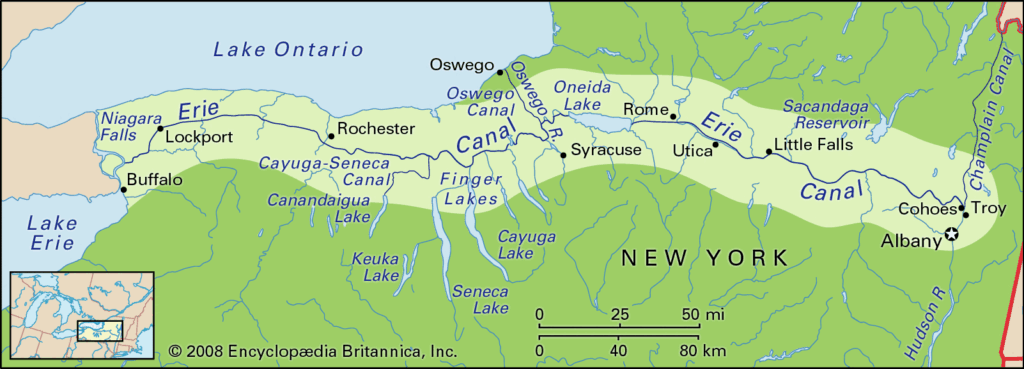
The Erie Canal got its name from its destination, Lake Erie, the second of the five Great Lakes traveling east to west. Ships could sail across the Atlantic Ocean from Europe and travel up the Hudson River to Albany, New York. There, for the first time, passengers and cargo were transferred to flat boats traveling west 363 miles to Buffalo, New York. From there, the rest of the Great Lakes and their major cities were accessible: Toronto north on Lake Ontario; Detroit on the western edge of Lake Erie; north through Lake Huron to the Mackinac Straits, which led south to Chicago down Lake Michigan or west across Lake Superior to Minnesota. It was a long trip, but as Chicago Sun-Times columnist Neil Steinberg put it, it was “easy compared to the previous system—oxcart—unchanged since ancient Greece.” He added it was “considered an engineering marvel on a par with the pyramids” and cut shipping costs by 90 percent.
At one point, we thought the Erie Canal construction might appropriately be linked to the Erie Shovel—the steam-powered excavator Local 150 restored that could have spared the backs of hundreds of laborers. Our research indicated it was not so. The Erie Canal was largely dug by hand, with excavated earth moved by horses and mules. But the next step in the story of American westward expansion did come by steam, as railroads rapidly displaced the canals built across the Country to transport people and products. Steam fueled by coal powered the Industrial Revolution throughout Europe and America, and for over the next 100-plus years was the backbone of the U.S. transportation system. But then came diesel fuel and the highways.
Believe it or not, in the early part of the 20th Century, roadbuilding was not a priority of the Operating Engineers union in most of the United States. Rural highway construction was basically a grading operation dominated by Teamsters. Illinois was an important exception. With mechanization of roadbuilding came more stable business organizations capable of making the significant investment in heavy equipment. The IUOE General President pushed local unions to organize highway construction in the 1920s. Local 520 in East St. Louis leveraged the organization of dams along the Mississippi River to organize highway construction as well. Local 841 out of Terra Haute, Indiana, straddled the Indiana/Illinois line and organized contractors there under a statewide agreement in 1937. Equally important was the passage of the Davis-Bacon Act by Congress in 1931, which required contractors on federally funded construction projects to pay “prevailing” (meaning union) wages.
But it was Local 150 that truly paved the way. Local 464 was the paving local in Chicago that became Local 150 in 1929. Then-President William E. Maloney, who by 1940 advanced to the IUOE General President position, pushed building contractors to perform highway work, who liked the flexibility roadwork brought.
Trucks and automobiles appeared as alternatives to horses and buggies in the early 1900s. The “Lincoln Highway” was the first of the “Big Roads” announced in 1913. It ran from coast-to-coast through the heart of America, was built and rebuilt over and over until the “U.S.” highway system emerged. The old names like Lincoln, Lee, and Dixie Highway gave way to numbers in 1925.
This federal highway system used odd numbers for those roads running north/south, while the east/west roads received even numbers initially ending in zeros. A ruckus erupted when it appeared that the state of Kentucky might not get a highway at all, because proposed U.S. 50 missed Kentucky to the north, while U.S. 70 went south. Logically, it should have gotten U.S. 60, but the original proposed U.S. Route 60 ran southwest from Chicago to Los Angeles in southern California.
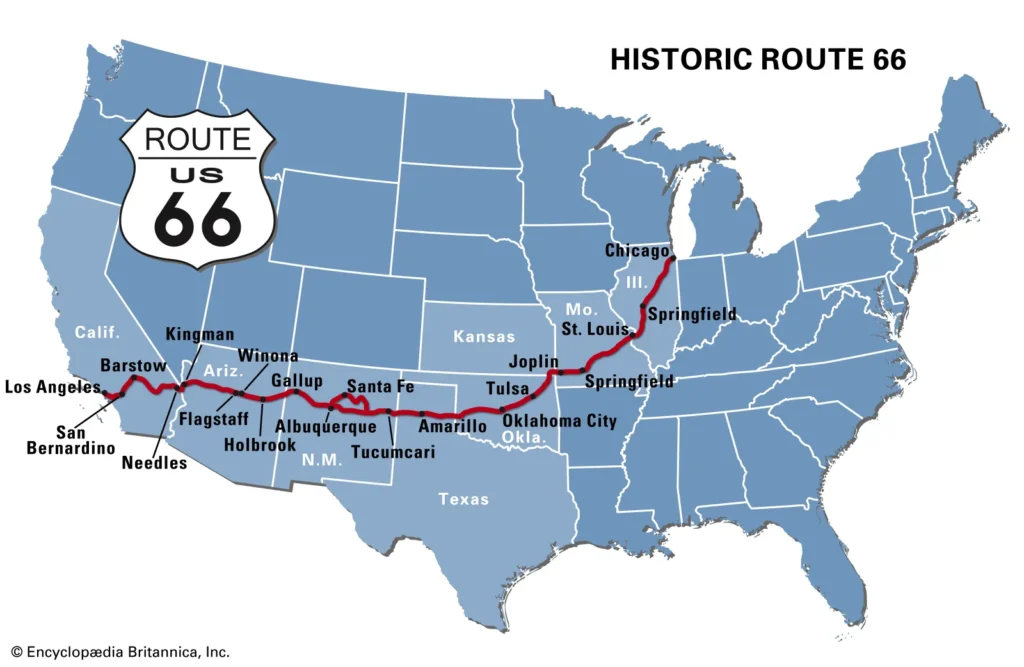
A compromise was reached with the Governor of Kentucky who got U.S. 60, and the highway planners switched the number on the Chicago U.S. Route to number 62. Oklahoma’s member of the planning commission, Cyrus Avery, told U.S. Bureau of Public Roads Chief Planner Thomas H. MacDonald, “We prefer 66 to 62.” And so, as Earl Swift, author of the book Big Roads put it, “The ‘Mother Road’ made famous by John Steinbeck in The Grapes of Wrath,” was born—Route 66.
Established on November 11, 1926, construction of Route 66 took several years. Starting in Chicago on Ogden Avenue in Illinois was the first state fully paved, but the paving of the entire 2,400-mile route wasn’t completed until 1938. Given the strong relationship between Local 464 and the paving contractors, there is little doubt the origins of the Mother Road, Route 66, were paved by Local 150 Operating Engineers.